Abstract

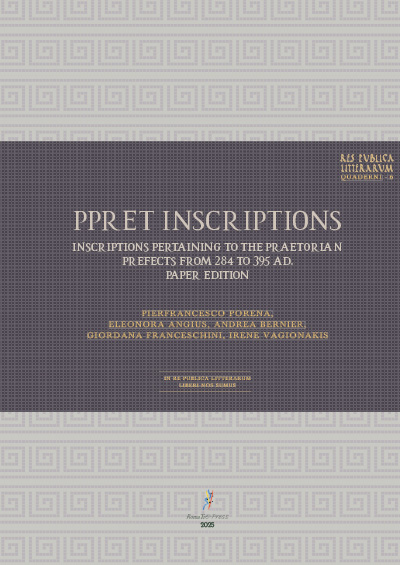
«PPRET» è il titolo del progetto di ricerca «Les préfets du prétoire de l’Empire romain tardif. Une élite face à la crise»/«The Praetorian Prefects in the Later Roman Empire: An elite in a context of crisis» (Strasbourg, Chaire Gutenberg, 2020/23) diretto da P. Porena (P.I.). Questo libro, che propone i risultati della ricerca, offre l’edizione critica, la traduzione plurilingue e il commento dettagliato di tutte le iscrizioni latine e greche nelle quali è menzionato un prefetto del pretorio in carica tra il 284 e il 395 d.C. (101 iscrizioni, di cui 29 in greco, 71 in latino, 1 bilingue, sia in prosa sia in poesia). Profili e carriere di questi prefetti del pretorio sono esaminati nel primo volume della Prosopography of the Later Roman Empire, pubblicato nel 1971, che non è stato aggiornato. Questo libro aggiorna l'epigrafia dei prefetti del pretorio del IV secolo (il 30% delle iscrizioni sono nuove). La varietà e la ricchezza dei testi (orazioni, dediche onorarie, epitaffi, epigrammi, epistole, testi legislativi, ecc., pagani o cristiani, pubblici o privati) è notevole. Il libro consolida e amplia l’omonimo database online (MISHA Strasbourg), che ha raggiunto un alto livello di elaborazione dei risultati della ricerca.

«PPRET» is the title of the research project «Les préfets du prétoire de l’Empire romain tardif. Une élite face à la crise»/«The Praetorian Prefects in the Later Roman Empire: An elite in a context of crisis» (Strasbourg, Chaire Gutenberg, 2020/23) directed by P. Porena as P.I. In this book all the Latin and Greek inscriptions, in which a praetorian prefect in office between 284 and 395 AD is explicitly mentioned, are edited, translated and examined in detail (101 inscriptions, i.e. 29 in Greek, 71 in Latin, 1 bilingual, prose and poetry). Evidence concerning all the praetorian prefects of the 4th Century are recorded in the first volume of the Prosopography of the Later Roman Empire, published in 1971, which has not been updated. This book updates the epigraphy of the praetorian prefects (30% are new sources). The variety and richness of the texts (orations, honorary inscriptions, epitaphs, epigrams, epistles, law texts, etc., pagan or christian, public or private) is remarkable. The book consolidates the homonymous online database (MISHA Strasbourg), which has reached a high level of processing of research results.