Abstract

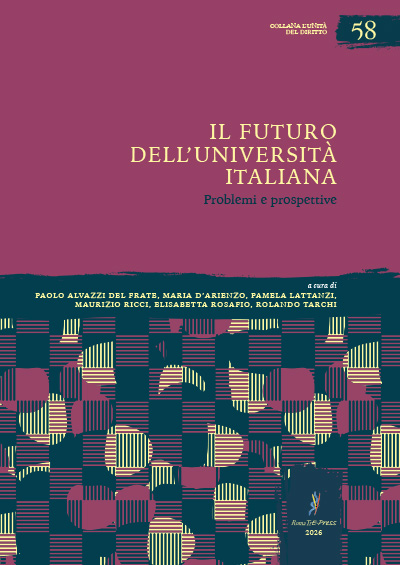
Il volume raccoglie gli atti del convegno «Il futuro dell'Università: problemi e prospettive», promosso dalla Conferenza delle Associazioni Scientifiche di Area Giuridica (CASAG) e ospitato dal Dipartimento di Giurisprudenza dell'Università Roma Tre il 19 marzo 2026. Il testo si articola in relazioni, interventi e appendice documentale, e affronta in modo sistematico le principali criticità del sistema universitario italiano alla luce delle proposte di riforma legislative, prima fra tutte il disegno di legge n. 1518/S (poi n. 2735/C alla Camera), volto a riformare il reclutamento dei docenti universitari mediante l’abolizione dell'Abilitazione Scientifica Nazionale. I contributi esaminano i profili costituzionali del nuovo sistema concorsuale, la governance degli atenei, la riforma dell'ANVUR nel quadro europeo di valutazione della ricerca, il finanziamento ordinario e le sue criticità strutturali, il reclutamento tardivo e la precarietà dei giovani ricercatori, il fenomeno della «fuga dei talenti» verso l'estero e la concorrenza delle università telematiche. Il volume documenta altresì la posizione critica delle comunità disciplinari (Aree 10, 11, 12, 13b e 14) rispetto al disegno di legge, di cui viene riprodotto il testo coordinato corredato dalle proposte emendative CASAG. L'opera si segnala per il dibattito sulla riforma dell'università pubblica italiana in una fase di profonda trasformazione normativa, demografica e tecnologica.
The volume also documents the critical stance adopted by disciplinary communities (Areas 10, 11, 12, 13b and 14) with regard to the bill, whose coordinated text is reproduced together with the amendment proposals put forward by CASAG.
The work stands out for its contribution to the debate on the reform of the Italian public university system during a period of profound regulatory, demographic, and technological transformation.">

The volume collects the proceedings of the conference “The Future of the University: Problems and Perspectives”, promoted by the Conference of Scientific Associations in the Legal Field (CASAG) and hosted by the Department of Law of Roma Tre University on 19 March 2026. The book is structured into reports, contributions, and a documentary appendix, and systematically addresses the main critical issues affecting the Italian university system in light of proposed legislative reforms, foremost among them Bill no. 1518/S (later no. 2735/C in the Chamber of Deputies), aimed at reforming the recruitment of university professors through the abolition of the National Scientific Qualification. The contributions examine the constitutional aspects of the new recruitment system, university governance, the reform of ANVUR within the European framework for research evaluation, ordinary state funding (FFO) and its structural shortcomings, delayed recruitment and the precarious conditions faced by young researchers, the phenomenon of the “brain drain” abroad, and the competition posed by online universities.
The volume also documents the critical stance adopted by disciplinary communities (Areas 10, 11, 12, 13b and 14) with regard to the bill, whose coordinated text is reproduced together with the amendment proposals put forward by CASAG.
The work stands out for its contribution to the debate on the reform of the Italian public university system during a period of profound regulatory, demographic, and technological transformation.